The Skills Framework for the Information Age (SFIA)
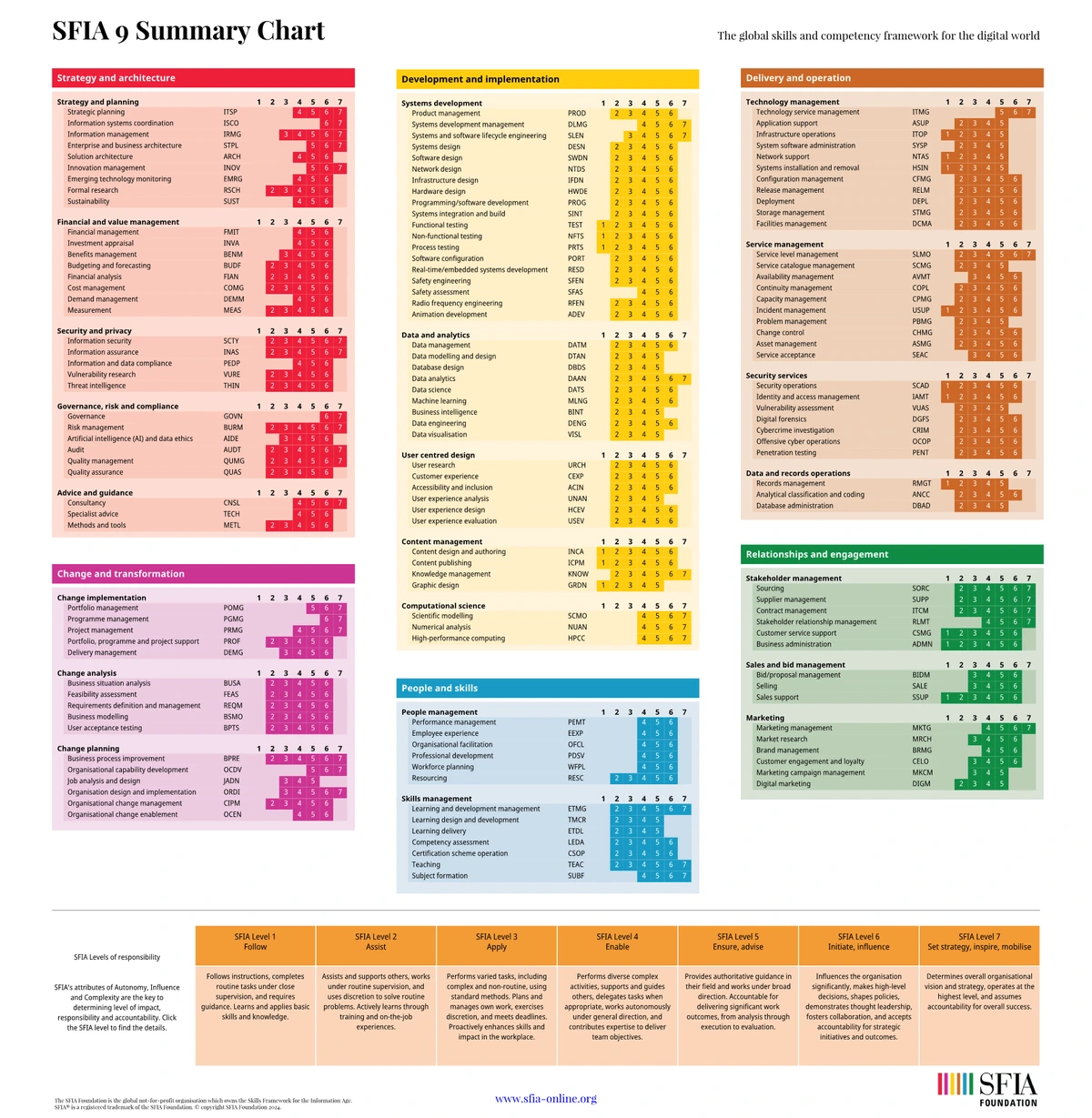
About SFIA
First published in 2000, SFIA has evolved through successive updates, shaped by expert input from its global users to maintain its relevance and value to industry and business needs.
SFIA provides a trusted, internationally adopted framework for defining the skills and competencies needed to deliver, manage and protect digital capabilities — including in critical areas such as AI, data science and cybersecurity.
From strategy and architecture to delivery, operations and change, SFIA offers a consistent, practical reference for developing people, shaping roles and building organisational capability.
In today’s connected world, a global framework supports local priorities, as well as international collaboration and cross-border growth.
Used by governments, industry bodies and employers worldwide, SFIA reduces duplication of effort. Rather than building a new framework from scratch, tap into a global community with decades of experience, proven approaches and ongoing support.
Why SFIA?
First published in 2000, SFIA has evolved through successive updates, shaped by expert input from its global users to maintain its relevance and value to industry and business needs.
SFIA began as a framework for the ICT community. It has grown into a framework that defines the skills and competencies needed by business and technology professionals who design, develop, implement, manage and protect the data and technology that power the digital world.
SFIA encompasses many of the world's most in-demand occupations, including professionals working in areas such as:
- information and communications technology
- business change
- digital transformation
- data science and analytics
- software engineering
- information and cyber security
- learning and education
- applied computing and computational science
- user centred design
- digital product development, sales and marketing
- human resource and workforce management.
How SFIA works
Explore SFIA’s seven levels of responsibility, outlining the progression of responsibility, accountability and impact, and how professional skills and generic attributes define competence and support professional growth.
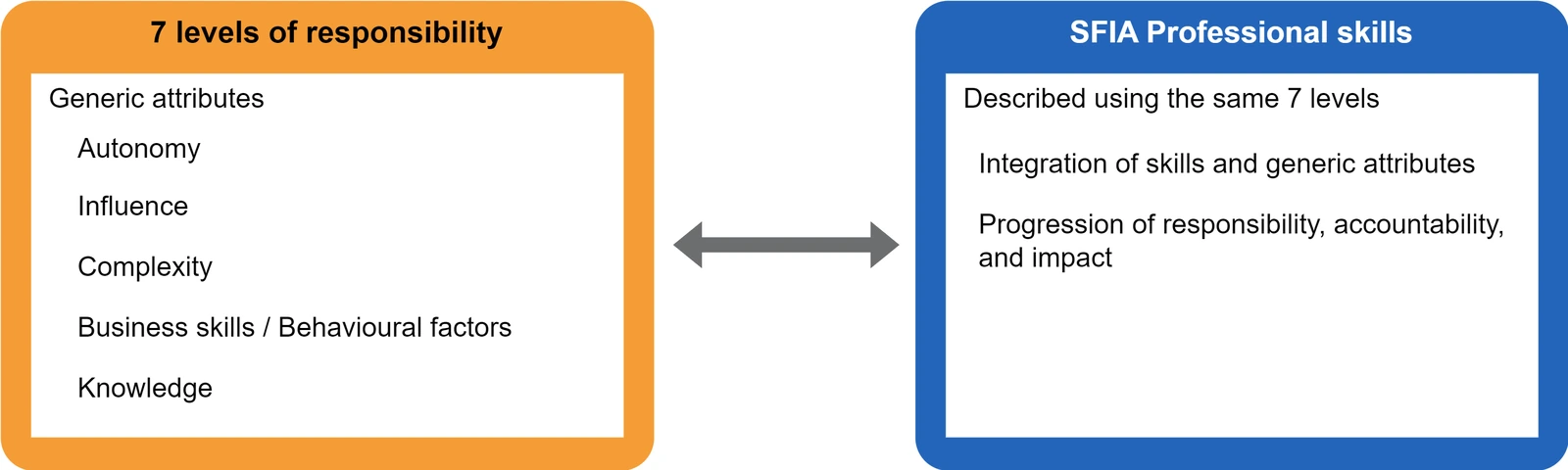
SFIA provides a structured approach to defining and developing professional skills and competencies in the digital world. At its core, SFIA uses a seven-level structure to describe both professional skills and generic attributes, creating a consistent framework for assessing and developing capabilities.
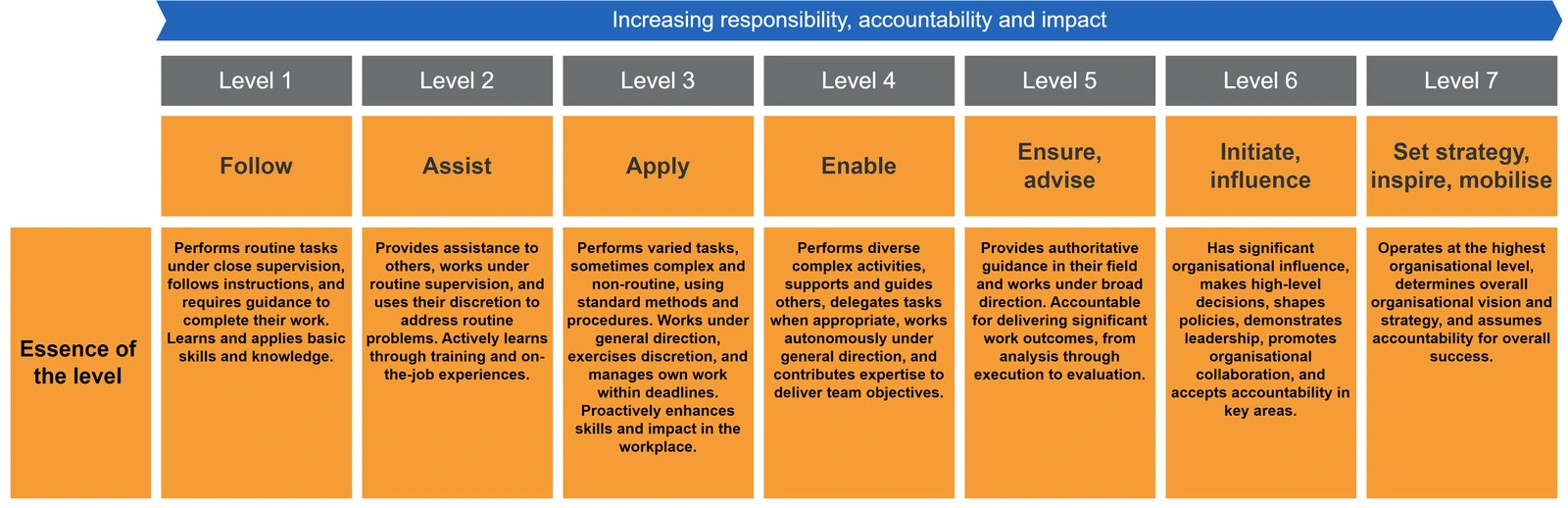
SFIA is structured around seven levels of responsibility, ranging from Level 1 (the lowest) to Level 7 (the highest). Each level represents increasing responsibility, accountability and impact in the workplace. These levels form the backbone of SFIA, offering a common language to describe roles across various professional disciplines.
SFIA describes skills and competencies at levels that reflect real-world professional practices in the workplace. Each level is carefully defined to be:
- Progressive: Building on the previous level's requirements
- Distinct: Clearly differentiated from adjacent levels
- Consistent: Using uniform criteria across all skills
The levels are characterised by specific behaviours, values, knowledge and characteristics that indicate an individual's operational capability at that level. This structured approach ensures clarity and consistency in assessing professional development across various disciplines.
Each level is also summarised with a guiding phrase:
- Follow
- Assist
- Apply
- Enable
- Ensure and advise
- Initiate and influence
- Set strategy, inspire, mobilise
Each SFIA level builds upon the previous one in terms of responsibility, accountability and impact, while recognising the value of all levels.
Essence of a SFIA level
Each of these levels is supported by concise essence statements, which provide a distilled view of the unique characteristics of each level. They help users easily distinguish between levels and understand progression without needing to dive into detailed descriptions.
Generic attributes
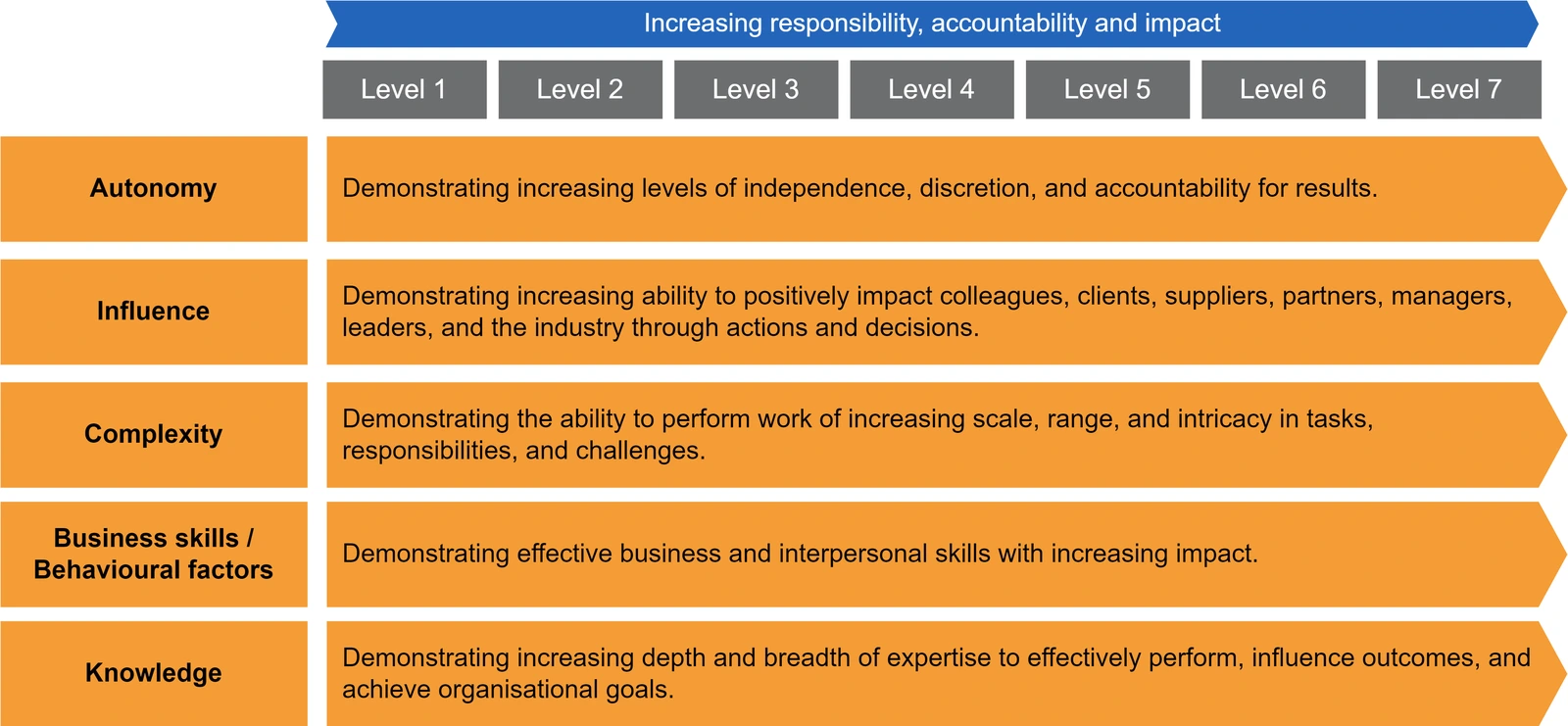
SFIA defines key attributes that are common to all the SFIA Professional skills and apply at each level of responsibility. These generic attributes describe how professionals operate within their roles and contribute to the organisation.
- Autonomy: The level of independence, discretion and accountability for results in your role.
- Influence: The reach and impact of your decisions and actions, both within and outside the organisation.
- Complexity: The range and intricacy of tasks and responsibilities that come with your role.
- Business skills/Behavioural factors: Effectiveness in areas such as communication, planning and problem-solving.
- Knowledge: The depth and breadth of understanding required to perform and influence work effectively.
By combining these generic attributes with professional skills, SFIA provides a complete picture of what is expected from individuals at each level. The generic attributes also help organisations assess and plan for professional growth, making it easier to map career progression and align roles with business goals.
SFIA and Untappedme
SFIA Integration
SFIA is integrated throughout Untappedme, harnessed across individual and organisation actors. SFIA underpins every user's account as a standardised measurement for competencies and knowledge. From completing a course on the learning centre to taking a self-assessment, your unique SFIA composition updates with your profile every step of the journey.
SFIA is an important metric that anchors your development to a standardised framework, exchangeable between organisations and countries. Your SFIA skills will travel with you across roles, departments, and promotions.
Furthermore, for organisations that want to embed their own skills, Untappedme enables you to create custom skills specific to your operations.
SFIA-based tools
Untappedme features a suite of tools based on the SFIA framework. These tools integrate with the underpinning SFIA taxonomy that is embedded within the Untappedme platform. Our suite of tools include:
- SFIA self-assessment
- SFIA peer review
- SFIA certification
- SFIA analytics
Learn more
You can read more about SFIA by visiting their website: